 Special Operations Executive: Resistance
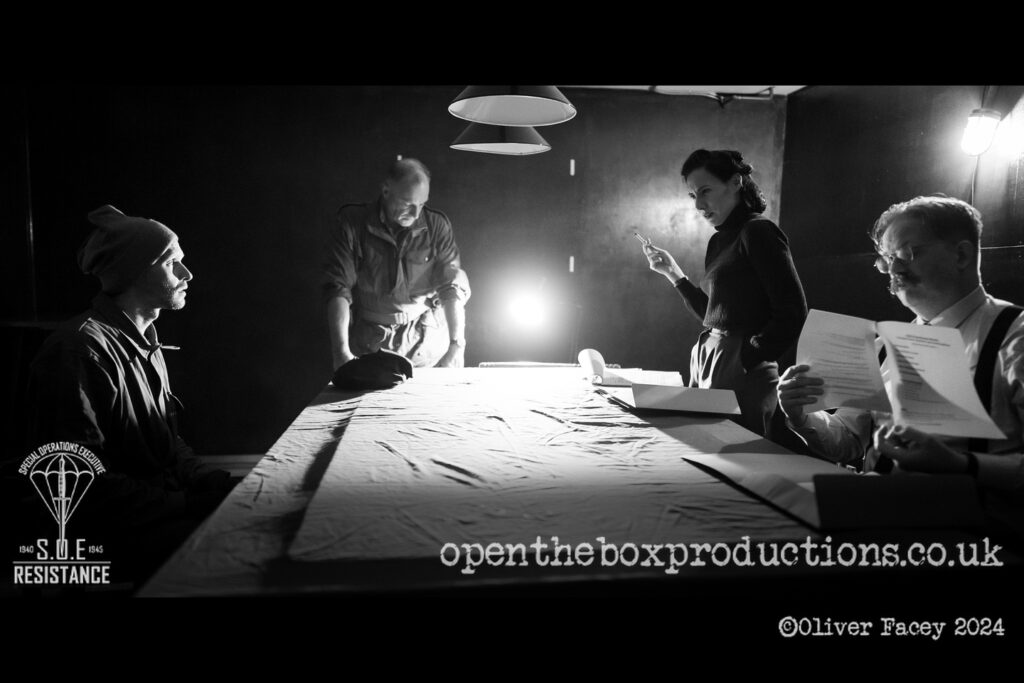
On the occasion of the anniversary of the end of an unpleasant war, we bring you a report from a foreign international larp. The article was created based on an interview and memories of one of the Czech participants, Jan Newman Novák. The larp will have further reruns and we hope that we will experience similar things only in this playful form.
The approximately two-day historical game by Open the Box Productions took place in western Britain, near Exeter. It was inspired by the training of agents during the Second World War, who were deployed throughout Europe. In order to get to their missions at all, they had to go through demanding training, including parachute jumps. Later, women began to be accepted in a similar way, because it turned out that they had significant potential in the field of obtaining information and other key tasks. So they were also present (and historically faithfully) at this game.
All from the first line
Larp tried to capture the breadth of training at the time as faithfully as possible. Players were divided into three categories – saboteurs, agents and intelligence officers. Saboteurs focused on working with explosives and combat, agents combined infiltration skills with information gathering, and intelligence officers focused on encryption, data collection and working with “soft skills” close to real intelligence practice.
A total of 36 players participated in the game – four colored groups of nine people, each consisting of three saboteurs, five agents and one intelligence officer. There were about twenty game instructors and a couple of NPCs who played Nazi soldiers, for example. The groups usually trained separately, either within the same profession or in various combinations.
Larp focused on the training itself, to which it devoted a significant part of its time. During it, players gained real historical knowledge – for example, about the use of explosives in wartime sabotage. Although these blocks were very interesting, they often took the form of face-to-face lectures that lasted for an hour. This could reduce the intensity of the active role-playing game. Some people might find it lengthy, but if you were interested in the topic, you had the opportunity to really dive deep.

Once we set up an ambush – a car carrying a high-ranking Nazi was passing by. The ambush was planned at a bridge on a bend. A colleague set up an explosive device and I was supposed to make sure no one left. As soon as the vehicle entered the bend, I started shooting. It was challenging – you tend to shoot twice, three times and think it’s done, but here you really had to keep shooting. It was the only ambush where there was a real gunfight, and the adrenaline was pumping. I shot the whole magazine: it would have been embarrassing not to do it properly.
The program started on Monday afternoon, continued all Tuesday and culminated on Wednesday with final tests. This phase was supposed to simulate the last part of the agent training. Wednesday then offered eight modular missions in which teams used the skills learned during the previous two days. The characters’ performances were evaluated (and in the end, all of them were recognized as agents capable of a hard mission).
The emphasis was on historical fidelity – not only in the roles, but also in the environment and props. The training seemed authentic, although of course it was not brutal – no one dragged anyone through the mud or tortured anyone. Safety – both physical and psychological – was, as with other international games, an important priority, but it was necessary to take into account that the space was not barrier-free. However, there was also one significantly obese player present, who was assigned the role of a scout and coped with it without any problems.
For example, when training close combat techniques, we first tried everything on a dummy with a rubber knife. It wasn’t a symbolic gesture – we really made real movements, as if we were really stabbing. It was very interesting because the instructor knew exactly how it was done back then, and he also had an authentic type of knife that was used at the time. But after about half an hour, it was announced that we would handle these situations differently in the game. The instructor showed us that a tap on the shoulder and a simple sentence, such as „save„, would be enough for the action. We also practiced procedures for neutralizing guards that we might encounter during the game. Some of these techniques then actually appeared in the game, which was great. For me, excellent work by the organizers and great teammates.
Background and difficulty
The game was played on an English homestead with a garden and there was a reenactor camp nearby. Accommodation was provided in a scout center, which you can imagine as a luxurious English villa with beautiful interiors. The players slept in rooms of four to six people, with completely adequate sanitary facilities.
The scenery was breathtaking – gardens, orchards, animal statues, architectural details – everything looked like it was from the Second World War. Modern elements were carefully covered up and there were period props everywhere. The reenactor camp had military tents, weapons, an American jeep, a truck and a Nazi armored car. The entire villa was fully used for the game and training.

The game was somewhat physically demanding.
The days were long – we got up for breakfast around eight and went to bed after midnight. You were on your feet all day. Mentally it wasn’t that demanding. There was a mock interrogation – we played detainees, we had cover identities that we had to remember. It was a bit confusing, but not hard or unpleasant. In the Czech Republic, much more intense games are played.
Sometimes there was running around, shooting from weapons that are quite dangerous in themselves, because they are basically just a tube with holes. If someone sticks their finger in it, they can hurt themselves. The fact that we could shoot from those replicas surprised me – I really held a gun in my hand and thought: How can we really do that? It probably had a slightly lower level of physical security than we are used to in the Czech Republic – but it was part of the atmosphere.
The larp was conceived as an all-inclusive game. Although the players did not get complete costumes, they were supposed to wear civilian clothes (for example, a suit, a shirt) that would correspond to the time. However, everyone received a green jumpsuit in which they spent most of the training. A practical solution, because no one had to worry about their belongings and could roam around the garden without any problems. Everyone also received props – for example, personal documents and an agent’s ID. One of the players even brought his grandfather’s documents, which were almost identical – the same stamps, format, visuals. The food was also excellent and took into account different diets.
The price of the game ranged between six and ten thousand crowns. But it was clearly visible where the money went – the quality of the facilities and organization matched the price.
Roles
The characters were probably partly based on real personalities who were active during the war. They were written briefly and there were a minimum of personal plots. Although each player was assigned a character, the personal plots were not fixed – they arose more naturally, through interactions during the game. Pre-prepared relationships existed only between known players, to ensure a safe environment. This was a bit of a disadvantage – you only had plots written with other Czechs, although playing with foreigners could be a much greater challenge and benefit.
The players played characters of different nationalities: each really played a character of their nationality. In addition to the three Czechs, there were French, German, British … The Germans, as resistance fighters, were of course also undergoing training there. The instructors were British, but they also played Americans. The language barrier brought interesting moments – it was possible to curse in Czech fully in-game or talk about the domestic resistance over a meal (the French, for example, commented that their resistance was often exaggerated). There was a friendly atmosphere among the players and (historical) national differences were a source of jokes.
Who would I recommend it to? Definitely anyone who is interested in World War II or agent training – this was a great experience.
Web: https://opentheboxproductions.co.uk/
Fotografie: Oliver Facey
Autor
Darien – Kristýna Obrdlíková 
Působí v Pardubicích, organizuje od roku 2007, tvoří převážně outdoory a v tomto kontextu se věnuje i focení a vzdělávání. Je součástí týmu Larpového newsletteru. Svůj čas tráví hledáním rozmanitých druhů inspirace a snahou o obohacení světa druhých.